

Your lock screen is the most viewed page in your life. You glance at it a hundred times a day, for the time, for a message, for nothing. Most people fill that glance with a photograph they stopped seeing months ago. A sad kobita wallpaper app fills it with two lines that still mean something, and on the hard weeks that small honesty helps more than cheerfulness would.
How deep the sad shelf runs
A lock screen poem only stays fresh if there are more waiting behind it. So we counted the sad shelf in our own collection of 2,179 works, using the theme tags recorded for every poem.
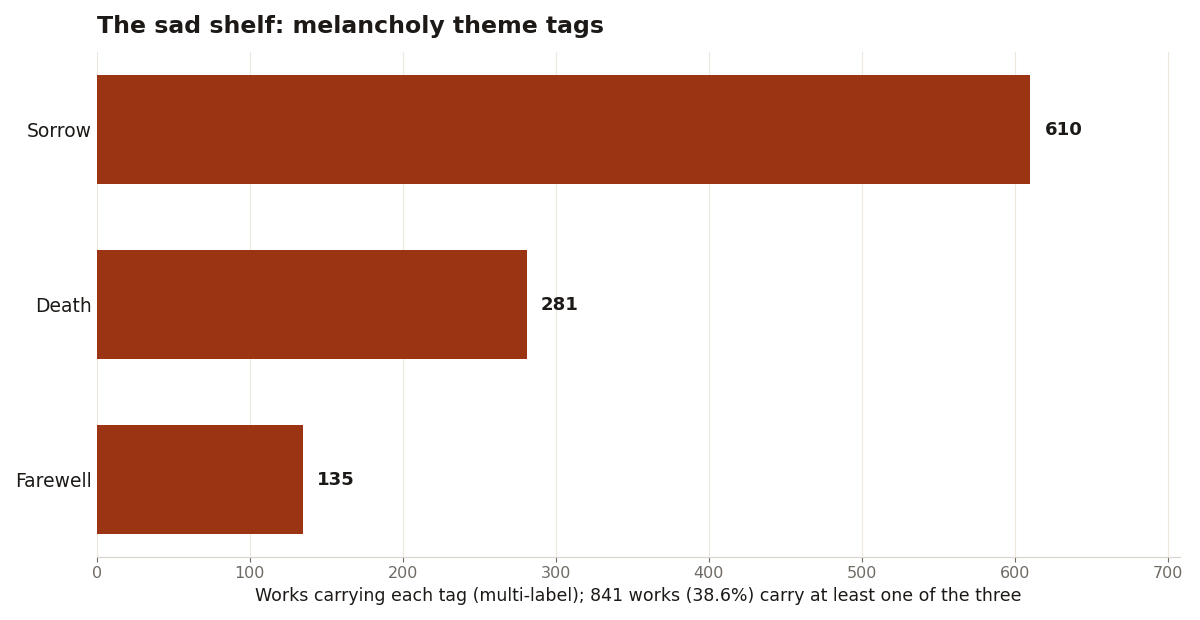
Sorrow is the single biggest melancholy tag: 610 works, 28 percent of everything we hold. Add the poems tagged with death (281) and farewell (135), counting each poem once, and 841 works carry at least one shade of sadness. That is nearly two in five poems in the collection. The depth is spread across voices, too: Tagore has 131 sorrow-tagged works here, Nazrul 81 and Jibanananda Das 74, and Jibanananda's share is why his lines suit a lock screen so well. At one new poem a week, the sad shelf alone would last a phone more than eleven years.
Five rules for a lock screen poem
1. Two to four lines, not a whole poem. "Keu kotha rakheni, tetrish bochhor katlo" fits a lock screen.
2. Dark background, light text. Readable at a glance, gentle at night.
3. Change it weekly. A wallpaper you stop seeing is just decoration.
4. Match the mood honestly. Sad poems for the hard weeks, gentler ones when life is kind.
5. Keep the poet's name tiny at the bottom. Credit, always.
Lines that were made for lock screens: "Keu kotha rakheni" (Sunil Gangopadhyay), "Hazar bochhor dhore ami poth hatitechi" from Banalata Sen (Jibanananda Das), "Chitto jetha bhayshunyo" (Tagore). Four lines, one glance, poetry all day, every unlock.
Which sad voice suits the week
Not all sadness in this collection sounds the same, and the counts by poet make a decent rotation guide. Jibanananda Das has 74 sorrow-tagged works here, and his sadness is quiet and tidal: rivers, fields, a face remembered across a thousand years. He suits the slow, tired weeks. Nazrul has 81, and his sorrow has a spine in it; even his grief sounds like it is arguing with fate. He suits the weeks when you are sad and angry at once.
Tagore's 131 sorrow-tagged works are the gentlest of the three, grief with a hand on your shoulder, and they suit the weeks of actual loss, when sharp lines would cut. Shamsur Rahman holds 45 and Sukanta Bhattacharya 41; Sukanta, who died at twenty, writes hunger and sorrow with an urgency the others never needed. A rotation that moves through these voices, one poet per week, keeps the lock screen honest: the mood changes because the poet changes, not because an algorithm shuffled.
There is one more practical reason to rotate. A line you see fifty times a day becomes invisible by Friday, which is why the weekly change in the rules above matters. The shelf is deep enough, 610 sorrow-tagged poems, that you never have to repeat one within a year. Let the phone remind you, and let the poet change.
One caution from experience: match the poem to the week, not to the worst hour of it. A line chosen at midnight reads differently at noon, and the lock screen is a noon object. Pick on Sunday, when you can judge the coming week with a cooler head, and let the choice stand. The deep shelf means there is always a truer line next week; you do not have to find the perfect one tonight.
Build this week's card free
You do not need a special app to make one. Our free Kobita Card Maker lays two lines over a clean background at phone size, with the poet's name kept small, exactly the format the rules above call for. Make one on Sunday evening, set it as your lock screen, and let the week argue with it. When it stops stinging, pick the next from those 610.
Sources: Banglapedia. The sad shelf is not a small corner of Bengali poetry. Counted honestly, it is more than a quarter of the house, and your lock screen is a fine place to keep its door open.