
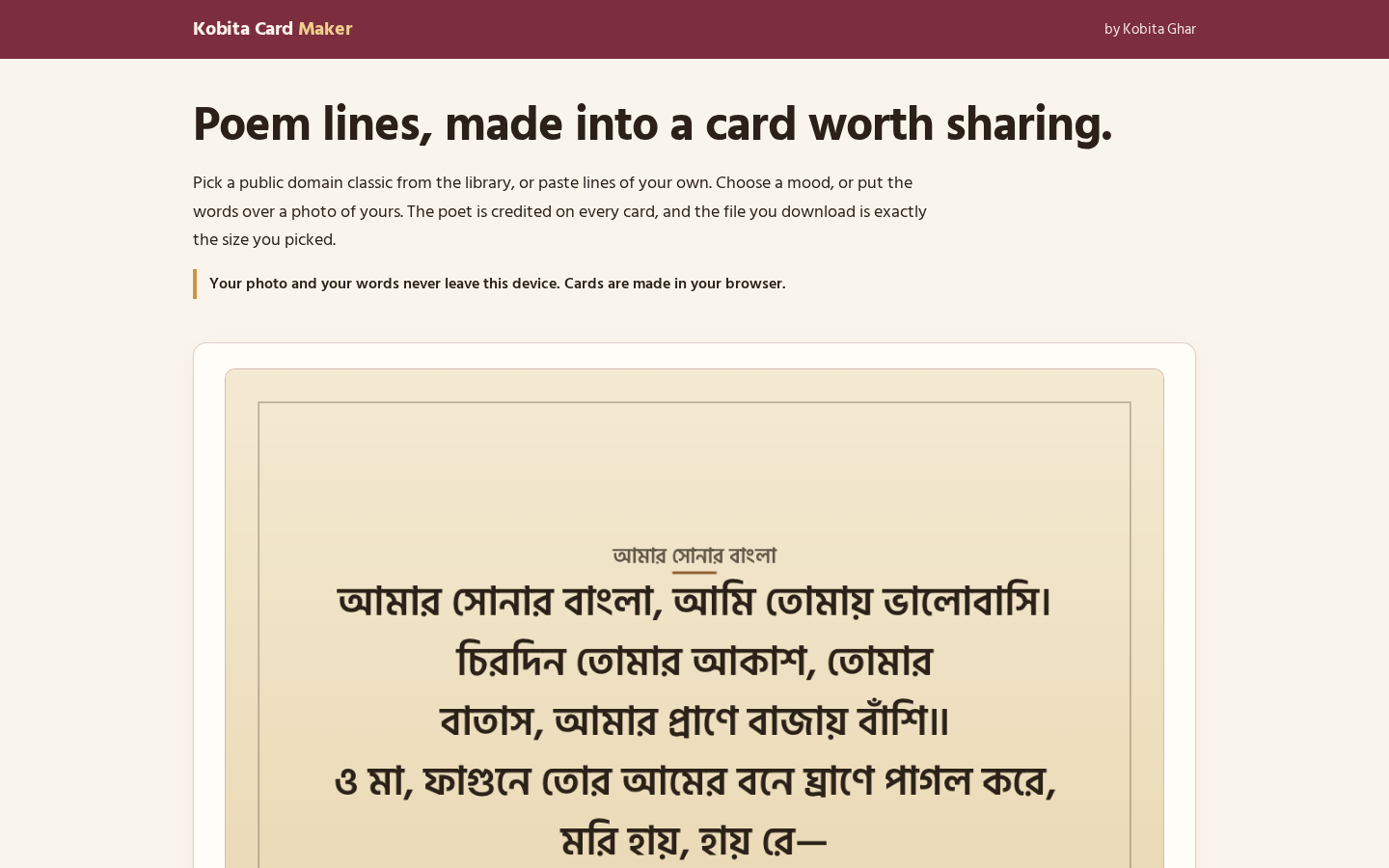
Start where this site's readers already live: dukher kobita, the sad poems. Pick the sorrow theme in the Kobita Card Maker, take the Sad mood and a vertical size, and a Jibanananda excerpt becomes a card that says the thing a status update cannot. Five more ways the maker earns its place:
1. Dukher kobita cards for the hard days
Our dukher kobita collection is the most read corner of this site. A card from it, sent privately to the one person who needs it, lands differently from a public post. Keep the text large and the mood Sad; let the lines do the work.
2. Love poems that travel further than a paragraph
The premer kobita shelf is built for slow reading, and the Love mood is built for the opposite: one excerpt, one card, straight into a chat. Square size suits a feed post; vertical suits a story.
3. A poem card in the family group, every festival
Our Facebook and WhatsApp sharing guide makes the point that poems in groups get read when they arrive as pictures. Make the card part of the ritual: Eid, Pohela Boishakh, a birthday, a death anniversary. The poet credit on every card keeps the lines attached to their maker as they travel.
4. Your own lines, set like a classic
The library is public domain only, so your own writing is not in it, and does not need to be: paste your own lines and the maker treats them the same way, same moods, same sizes. It is the fastest honest test of whether two lines of yours can stand on their own before you share them anywhere else.
A variant worth knowing: instead of a mood colour, put the lines over a photo of yours. A village road in the rain under a river poem, your father's courtyard under a mother poem. The photo does the remembering; the lines do the saying. Keep the photo plain and the text size up, or the words fight the picture and both lose.
5. A lock screen that changes with your mood
Vertical cards are the shape of a phone screen. The wallpaper guide covers apps for this; the card maker skips the app and hands you the file directly. Make one for the week, not forever.
6. Read the originals, then card them
Every excerpt in the library comes from a public domain text, and the full poems live at Bengali Wikisource, free for anyone to read. Read the whole poem there, then come back and card the two lines that stayed with you. On story nights the same habit works for audio: the Horror Story Poster Maker at ShunoGolpo gives tonight's story its own artwork. Pick tonight's lines: open the Kobita Card Maker.